
Give every section a defined role
A long perimeter can include several fence styles, different adjoining uses and access points needed at different stages. A single total length does not explain those changes or tell an installation team which sections are ready.
Our guide to types of fencing helps you compare materials and privacy needs before completing the fence-line register.
Our development fencing packages coordinate supply, programming and installation. We use the project scope and drawings to discuss what each section needs and how the work connects to the construction programme.
For a Manawatū enquiry, send the exact property address. The wider region includes properties under different territorial councils, so record the authority for your site alongside its boundary information.
Create a fence-line register
| Section information | What it resolves |
|---|---|
| Section ID and drawing | A start point, end point and current drawing revision make the work area identifiable. |
| Length and specification | Record the length from your plans, fence type, finish and design detail. Identify what still needs site confirmation. |
| Gate and transition | Reference adjoining gates, changes of style and changes in ground level. |
| Release stage | Name preceding work, access restrictions and the person who confirms the area is ready. |
| Handover evidence | Record the inspection, accepted finish, outstanding items and the person accepting the section. |
For example, section F03 might be ready for installation while its adjoining gate remains a construction entrance. List the gate separately, with the event that allows it to be completed, so the two items can have different release dates.
A staged Palmerston North boundary package
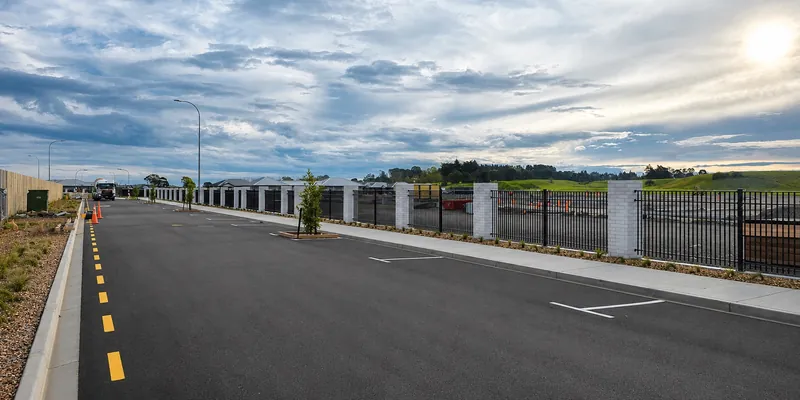
Development Boundary Works, in progress
Our Palmerston North perimeter fencing project includes multiple fence styles across a major development site. We are delivering the works progressively in coordination with the wider programme.
Mixed specifications make clear section references useful: an agreed detail for one run should not be applied to a neighbouring run with a different purpose. Keep material changes and gate requirements visible in the register and drawings used on site.
Plan the release of each work area
- Confirm the line. Have the owner or appointed specialist provide the boundary and set-out information.
- Check preceding work. Identify earthworks, services or neighbouring construction that affects the section.
- Protect necessary access. Record delivery routes and entrances that must stay available.
- Approve the section detail. Resolve changes of style, level and gate interfaces before installation.
- Close out the stage. Record inspections and remaining work before the next part of the programme depends on it.
For Manawatū District properties, check the Council's fence and planning requirements for the proposed work. Palmerston North properties fall under a different city council. Include the applicable approval responsibilities in the scope.
Price a consistent specification
Send the same fence-line register and drawing revisions with each request for pricing. Ask quotes to identify supply, installation, gate work, access assumptions and exclusions against those references. This makes a missing item easier to spot than comparing totals alone.
If the perimeter meets outdoor finishing work, link its release stages to Palmerston North landscape zones or your Feilding landscape finish schedule. For a programme spanning regions, our Hawke's Bay fencing page covers a boundary-and-gate brief for operating properties.
Questions about your project
Can one package include different fence styles?
Yes. Our development boundary work includes multiple styles. Identify each section and its specification so supply, installation and transitions can be coordinated.
What if sections become available at different times?
Record a release stage for each section, including preceding work and access restrictions. We can then discuss installation around the development programme.